Showing posts with label Storytelling. Show all posts

Wednesday, April 1, 2015

Week 11 Storytelling: The Magic in Music


“Happy Birthday!” Olivia’s father boomed as he walked through the kitchen door, a large wrapped parcel in his hands.

Smoke from the candles Olivia just blew out still lingered in the air as her mother began cutting pieces for everyone.

Olivia’s eyes lit up at the size of the package. Her father set in on the table in front of her and she immediately began tearing off the wrapping paper. Pieces flew everywhere as her parents looked on with loving smiles. Olivia unwrapped an old leather case. It smelled musty and was practically falling apart at the rusty hinges. Hesitant, she looked over at her father. He urged her on with a look and, with much difficulty, she unlocked the case and swung it open. Nestled between two layers of silk was a fiddle.

Now, to the eyes of a ten-year-old, the instrument was no more than a weird-looking guitar made of wood and string. But the instrument was in fact one of immense beauty. Etched coils and curves followed the outline of the fiddle. At the middle of the instrument, a young woman’s face was carved with skillful detail. Despite its obvious age, the thing boasted a smooth, finished surface. The strings seemed to glint in the light like fine, silky hairs. And Olivia sat staring at it, unimpressed.

“But, I don’t even know how to play,” she began to whine to her father. He just chuckled and moved closer to pick up the instrument himself.
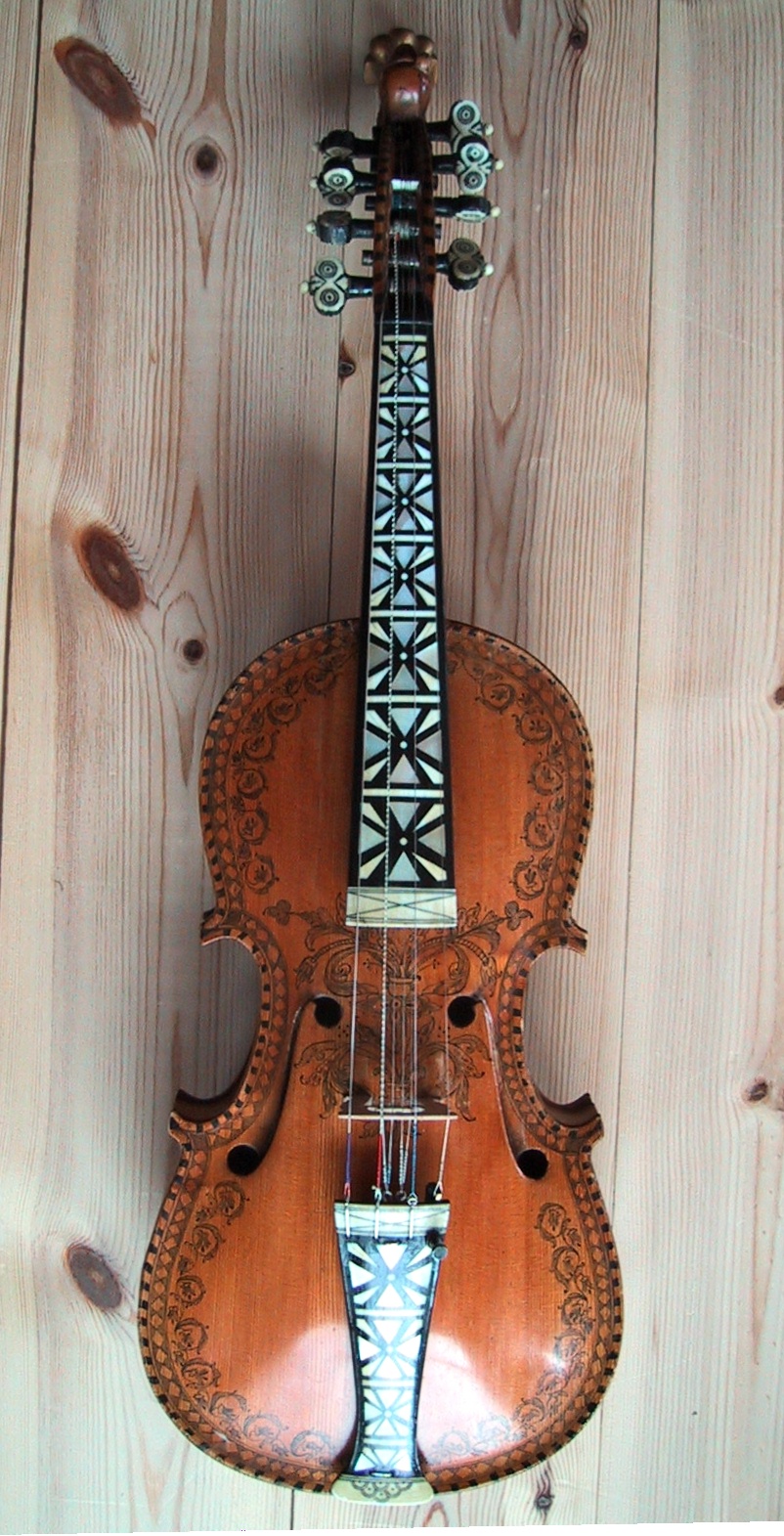
Fiddle
“Ah, you’ll learn in no time, my dear. I was just as unskilled as yourself when I first got it. Though I’ll admit, most of the time I felt as though it made the music on its own.” He gently began to play, producing the saddest, sweetest sound Olivia had ever heard.

Over the next few months, Olivia began to practice every day. She learned at an almost alarming rate and, before long, was playing almost as well as her father. Her mother was astounded at how quickly she picked up the skill, but somehow her father was not surprised. 

Some years later, Olivia's father became very ill and passed away. Devastated by the loss of her father, she could not even think to pick up her beloved fiddle to play. Weeks went by and it sat in her room, collecting dust. Eventually, she moved it to the back of her closet. Seeing it was a constant reminded of her father and his absence. 

One night, not long after her father's death, Olivia lay in bed. The sun was slowly falling below the horizon and the stars began to twinkle gently in the sky. Drifting somewhere between sleep and consciousness, Olivia heard music playing. Thinking she was dreaming, she let the soft, sad tones lull her into a peaceful safety. She did not cry or smile, but just lay quietly. The music became louder. Olivia opened her eyes. Was she awake or was this a dream? She couldn't tell. The music was coming from her closet. She silently approached the door and opened it. The music suddenly stopped. She looked curiously into the closet but saw nothing. She shrugged her shoulders and closed the door. 

She turned to lie back down only to find a young woman sitting on her bed. Slightly startled, Olivia jumped back against the closet door. The young woman started up. 

"Please, do not be afraid. I am not a stranger. In fact, we know each other very well. I am Lyla, the gift your father gave you many years ago."

Olivia looked at the woman skeptically. "Are you trying to tell me you're a fiddle?" she asked. 

Lyla chuckled. "I suppose it does sound silly, but it is the truth. Or partly, anyways. I am a human, undoubtedly. But I reside in the fiddle. The one you cherish so much. The one your father cherished so much before you." Her tone was sympathetic and warm. 

Olivia's skepticism faded at the mention of her father and tears brimmed her eyes. 

"Please do not cry," Lyla pleaded. "I loved him too, very much. Never before had I been played or cared for so lovingly and carefully. Only you have proven to be a more attentive caretaker."

The two sat on the bed in silence for a few moments. "Would you like me to play your father's favorite song for you?" Lyla asked. Olivia did not respond, but lay down in silence and closed her eyes. 

Lyla put her hand over Olivia's and began to hum a familiar tune, one that Olivia's father used to sing to her when she was a child. With that, the two girls both drifted into sleep to the swell of the sweet, sad song.

~~
Author's Note: This story is based on "The Magic Fiddle" from the Indian Fairy Tales unit of the Untextbook. In the original story, a sister lives with her seven brothers and their wives. As a result of a curse the women had placed on the sister, she drowns and is transformed into a Bonga. (At first, I didn't know what a Bonga was. However, Laura informed me that they are basically a kind of spirit or fantasy-type creature. They can be almost any kind of spirit). She then reappears as a bamboo and is cut down and made into a fiddle. The fiddle ultimately ends up in the hands of the chief and, every day, the Bonga girl would come out of the fiddle and make dinner for the household. Eventually she is caught by the chief and somehow she became both a human being and a Bonga and they married. 

I decided the twist this story a little bit because when I read it I thought,  "How awful would it be to be stuck in a fiddle? To be an object and be passed around without any say?" Here, as in the original story, she doesn't seem to mind being in a fiddle. And even more so in my story she embraces it. I tried to think of a good reason why the Bonga girl would reveal herself to someone, despite being in the family for so long and never doing it before. I thought if she had a connection with Olivia, it would make more sense as to why she appeared before her. So, I added in the tragedy of losing a father. The part about appearing to Olivia in a dream (or was it?) added a fun mystical aspect. 

Bibliography:
Indian Fairy Tales by Joseph Jacobs (1912).

Thursday, March 12, 2015

Week 9 Storytelling: What the Water Taught Me

Arjuna was sitting on the damp ground next to a vast river. The breeze softly rippled the surface, distorting the fish and plants that were living quietly underneath. He sat quietly observing the sky, slowing growing darker as gray clouds approached. His own mind clouded as he looked back on his first year of exile. Sadness filled his heart as he thought of his brothers, who he had left behind.

He tried to push those sad and bitter feelings out of his heart and head. He closed his eyes and did his best to clear his mind and steady his breath. He heard a low humming, like a song coming from someplace far away. He opened his eyes. There was no one around him. All was still. Arjuna closed his eyes again and tried to meditate. Again a humming seemed to vibrate his mind, spreading an odd calm through him. Rather than try to find its source, Arjuna accepted the sweet sound and let it roll over him. Suddenly, he opened his eyes. He felt the need to bathe. Slowly, he removed his clothing and stepped into the lake, feeling at peace despite the water's chilled temperature.

Once submerged fully in the water, Arjuna opened his eyes and found that he could breathe as easily underwater as he could minutes ago on land. Somehow, this was no surprise to him. The radiating humming had become stronger than ever, keeping his mind and body at ease. He saw something move below him and swam towards it. As he approached it, the humming stopped abruptly. A girl emerged from the dark waters below. Her eyes seemed to glow, giving Arjuna the same sense of calm throughout his body. He tried to speak, but his words were inaudible in the depths of the water. 


Mermaid (Source)

"You don't need to speak here." Arjuna heard the voice in his head. Startled, he tried to speak again to the girl in front of him, but his lungs suddenly filled with water.

"Don't speak, human, just think," the voice spoke to him again.

"Who are you?" Arjuna thought, both to himself and the girl.

"My name is Ulupi, I am the princess of Naga, this netherworld which you now find yourself in. Who are you?" Her voice seemed calm yet strange, like no sound Arjuna had ever heard before.

"I am Arjuna. Why am I here?"

The girl looked back at him with blank eyes. She seemed to be thinking, though he heard no words. "Why do you think you are here?"

"I broke a promise of privacy to my brother and wife. As punishment, I have been exiled for twelve years. It has only been a year since then, and I am traveling to as many holy rivers as possible. Although I did not mean to bathe in this one, I felt drawn to it as if it was something I was supposed to do."

Light seemed to gleam down in patches as the clouds above began to pass, illuminating the dark waters. When the light shined, parts of the depths became visible and Arjuna could see in the distance tall, wave-like structures. The sunlight disappeared, and so did the life below.

"Perhaps," Ulupi's voice interrupted Arjuna's trance, "you would like to come down with me into the water." Her body, shaped like a human's from the waist up but covered in scales, seemed to shimmer and glow at the idea.

"I do not think that is what I am meant to do..." Arjuna meant to think to himself, but he knew Ulupi heard it, too.

"Your time in exile has not been spent as it should have been. You must continue on, travel further, journey wider. It is there that you will find happiness," she stated coolly.

A sense of dread overcame Arjuna at the thought of another eleven years away from his family and loved ones. The water seemed to darken around him. His mistake seemed so heavy on his heart that he did not't think he would be able to go on.

"Remember, Arjuna," Urupi seemed to brighten from within, "you will be united with your family again. Love will not be a stranger to you. But you must move forward to find it."

Suddenly, Arjuna couldn't breathe. He swam as fast as he could to the surface, but it seemed miles away. Water filled his lungs and he jerked forward.

He was on the riverbank and the clouds were still coming in to darken the sky. He looked around, astonished at what he had just experienced. Had it just been a vision? After a few moments, he smiled to himself and walked on.


 ~~

Author's Note: This story is based on Arjuna's character in Narayan's "The Mahabharata." After he and his brothers marry Draupadi, Arjuna breaks the rule of interrupting his wife when she was with his brother. As a result, he was exiled for twelve years. The story only says that he was meant to bathe in holy rivers, and meanwhile he married Urupi, the serpent princess, and Krishna's sister. I was immediately intrigued with what a serpent princess would be like, so I decided to elaborate on their meeting. After doing some research, I found that the story goes that Urupi fell madly in love with Arjuna while he was practicing a religious ritual. She essentially drugs him, drags him to her world under water, and says she will only let him go if he agrees to marry her. Well, that just seemed like a story I wasn't ready to get into. So, I decided to merely use the same characters and setting and create a fantasy-like encounter between the two of them. I have no idea where the concept of having them talk only with their minds came from, nor do I know if it adds or takes away from the story at all. I picked the image I did because I wanted her to be dark, but not in a scary or threatening way. I think this picture conveys that. 

Arjuna's Exile
Narayan, R. K. (1978). The Mahabharata.

Wednesday, February 11, 2015

Week 5 Storytelling: The Dream

The red sky (Source)

Dear Rama,

My stay with Grandfather has been very pleasant. I wish you and the family were here to enjoy time with him, too. Last night I had the strangest dream. It's left me a little shaken, to be honest. You've always been able to give me sound advice. Maybe you can make something of it!

I was walking along the ocean shore. The sun was setting, tinting the sky red and orange. The soft waves were lapping at my feet, and I felt completely at ease. I stood, facing the ocean, and closed my eyes. I felt the water pool around my ankles and then retreat with the tide. I waited for it to come back, but felt nothing. I opened my eyes and water was rising up into the sky. As if it were raining upside down, the water going from the ocean into the clouds. I watched on and in seconds it was gone. The ocean was gone. All I could see for miles out was rock and mud. Fish and plants lay dead without their source of life.

Terrified, I ran home to tell father what had happened. As I approached Ayodhya, I noticed no fires were lit in any homes. The sun remained near the horizon but would not set, casting long shadows. The sky seemed red and angry. The air was so still and dry. I could hear the elephants cry loudly, their bellows cracking through the air like thunder. I looked around to try and help the ailing animals, but could not find them. All that could be heard were their painful laments. I slowly began to walk up the palace steps and felt something beneath my feet. I looked down and saw shattered pieces of something. I bent to get a closer look and realized the cause of the elephants' cries. Their tusks, big and sturdy, had fallen and shattered into thousands of pieces.

I ran up the palace steps hoping, needing to find anybody. Though I climbed and climbed, they did not seem to end. Finally I reached the top of the stairs and was high in the sky. The tall tower crumbling beneath me. Frantic, I tried climbing higher until I reached the very top. The sun finally began to dip below the horizon. Below me the earth burned with red light. The moon appeared in the high night sky. Its face resembled my mother's. 

"Help me! Please!" I cried out to it, afraid I might fall.

"Jump onto me,  and I will keep you safe," it replied.

Just as the last step fell to the Earth, I reach up and grabbed the moon. I pulled myself up into its curve. I felt cool sweat on my forehead, but began to calm. Only moments later, the moon and I began to fall. Smoke and sun glared up at us from the ground and I screamed. I called out for you, Rama, but you were not there. Just before I hit the ground, I woke up.

I don't know if it means anything at all or if it's just a silly dream, but I cannot help but feel uneasy about it. What do you think, Rama? Please respond speedily, as your words will calm me. I see three horseman with the Ayodhya flag coming up to grandfather's palace. Perhaps they have a message for me!

I miss you, dear brother. Give my love to father and the rest.

Love,

Bharata


----

Author's Note: This story was adapted from William Buck's "Ramayana." In the chapter titled 'Bharata Returns,' Buck mentions that right before the horsemen arrive to give him news of his father's death, Bharata awakens from a bad dream in which he sees the ocean dry, the moon fall, his father's elephants' tusks shatter, the fires of Ayodhya go out and smoking rising from the Kosala hills. I included all of the elements into my story and expanded upon each one, telling a detailed account of the whole dream. 

I decided to expand on this part of the story because I believe dreams can be a really fascinating way to see view our lives. Sometimes, they are meaningless. Other times, dreams can be an outlet for our subconscious. In storytelling, dreams can also be a great way to either foreshadow or express a character's feelings in a more descriptive way. Bharata is an interesting character in that he is offered a kingdom, and yet can see that Rama is truly meant to rule. He feels anger towards his mother and loyalty towards Rama and his father. I wanted to expand on Bharata's role and allow him to have a kind of adventure of his own (even if it is only in a dream). It is obvious in the Buck's story that he does not want to rule, and hopefully my story conveys that he really doesn't even have the ability to rule. He is always asking for help or seeking someone else.  

Buck, William (1976). Ramayana: King Rama's Way. 

Thursday, January 29, 2015

Week 3 Storytelling: The Mad Monkey

Brooklyn Museum - Rama and Lakshmana Confer with Sugriva about the Search for Sita Page from a Dispersed Ramayana Series.jpg 
Rama and Lakshmana conferring with Sugreeva (Source)


“Human Breaks Through City Walls, Terror Is A Misunderstanding.”

The words ran across the front page of every newspaper in Kishkinda. Steve dropped the paper on the kitchen table with a sigh.

“I just don’t understand,” he grumbled aloud. “Why do we keep helping these humans who come through our city? All they do is cause trouble for us! I remember when this town used to be safe. A monkey could go to work without worrying about getting mauled by an angry man.”

His wife, Linda, came up behind him and rubbed his shoulders sympathetically. “I know, dear, it’s an awful thing to see. But don’t worry, they’ll be gone soon. Sugreeva will help them find that man’s wife and we will have our home at peace again,” she reassured him.

“Don’t even get me started on that lazy ass Sugreeva. We were doing fine with Vali as king. Then his brother had to get involved. Assassination, corruption…” Steve pushed away from the table and walked over to the window. “We’d be better off not being able to communicate with that species at all."

“We’ll be fine! The city is strong and the King would never let any harm come to us. You don’t have to worry.”

Steve pressed his forehead against the cool glass and closed his eyes, a dull pain forming between them. “Please, Linda, I don’t want to talk about this anymore. I’m going to bed.”

With that he went upstairs and shut the world out, slipping into the warm pleasure of ignorant sleep.

-

The next morning, Steve walked into work not feeling any better. As he passed the spot where Lakshmana had torn down the palace gate, bitterness surged through him. He hurried up to the office. Inside, there was a buzz of energy as people whispered about the prior day’s events. He sat down, his body already feeling heavy and exhausted before the day even began.

“Hiya Steve!” Glen’s goofy smile popped up over the cubicle wall. “Crazy about the attack yesterday, huh? No worries, though! Hanuman says everything is fine. All a big misunderstanding! Which, boy oh boy, made me feel a lot better because we’ve got that company bowling tournament this weekend and…” Glen rattled on and on about Vishnu knows what. Steve closed his eyes, that dull pounding coming back between them. The phone at his desk began to ring again. The prattle echoed in his ears.

Clenching his teeth, Steve interrupted, “This isn’t really a good time, Glen.”

“Not a good time? Oh come on, Steve-O! Buck up! Don’t you worry about that tournament. I’m a great bowler!” Glen laughed. The phone kept ringing. Somewhere down the hall the copier was jammed and screeching. Glen was going on about bowling. The phone again.

Steve snapped. He jumped up out of his chair and ripped the phone out of wall and threw it on the floor. A silence fell over the office and they all turned to look at him. Glen stood stupefied.

“Are you all IDIOTS? Don’t you know that this isn’t going to just go away? Our palace wall was blown to pieces not twenty-four hours ago!” He yelled and turned to Glen. “And I don’t give a rat’s ass about the stupid bowling tournament!” He stormed off, muttering to himself about the idiocy of his own monkey race. 

He decided to walk home, wanting to calm down before seeing his wife again. The air was cool, and some moisture remained from the long rainy season they had. The breeze blew through the tree tops and rustled the leaves. He took a deep breath.

“Am I going crazy here?” Steve thought aloud. “Why am I the only one who sees the danger in getting involved with these humans? No good can come of this, I know it. I feel it…” His thoughts consumed him all the way home. When he reached the front door, he took a moment to collect himself. He spread the best smile he could muster across his face and opened the door.

“Hello, darling, I knocked off early fro-”, he stopped. The living room was dark. He looked around confused. Closing the front door, he walked into the kitchen, also dark. He was about to go look upstairs when he heard shuffling at the table. He turned on the lights and saw Linda sitting there, staring at the wall. She was holding something, although he couldn’t make out what it was.

“What are you doing? What’s wrong?” That pain was coming back.

Linda didn’t say anything. Her fingers traced along the edges of what Steve now saw was an envelope.

“Linda?” Steve asked again. Nothing. “What is that?” There was fear in his voice now.

Finally Linda turned, her face coming into the light. Her eyes were rimmed with tears, although her face was expressionless.

“We’re going to war. Against the rakshasas.” Her voice was slow and calm. She looked up at him, her face finally breaking into tears. 

“They’ve called you to fight.”

~~

Author's Note: This story is based off of the monkeys who Rama and Lakshmana encounter in Kishkinda in 'The Ramayana.' The original story itself does not really offer much information about the monkeys who live in Kishkinda, only the major characters like Vali and Sugreeva. While I was reading the part of the story involving the monkeys, I found myself wondering how normal it is in epics that animals can talk. Interestingly enough, their behavior is based on human behavior. You would think that animals would be a little different - although that is mentioned once when the brothers are fighting each other. Jokingly, I thought that animals probably wish they never even knew how to talk to humans. That way, they would never get asked for favors and never have to get involved in battles and search parties that don't involve them. Eventually that led me to creating a back story for the monkeys who end up fighting for Rama in the Battle of Lanka. The interesting part is that while I was writing, I found a lot of the sentiments relevant to today (even though I was writing about monkeys). I tried to add some humor to make it more of a dark comedy type. 
  
Bibliography: Narayan, R. K. (1972) The Ramayana.
 

Wednesday, January 21, 2015

Week 2 Storytelling: The Girl of the Forest


There once was a girl born of the Earth. She had no family except the animals and the trees. Wandering the woods, she spent hours with the things she loved most. The flowers knew her scent, and the birds knew her voice. She was the mistress of the Dandaka forest and was endlessly content with her surroundings.  

One soft, summer afternoon the girl, Soorpanaka, was lounging beneath the shade of a large oak, trailing her fingers in the cool river beside her, humming along with the birds above. Suddenly, a dark vibration filled her body and chilled her. The birds stopped humming. The rippling of the river ceased as it stilled with suspense. Soorpanaka heard the crunching of leaves under a heavy foot and quickly climbed the large oak and peered down. Below she saw a creature exuding more evil than she had ever felt before. She had heard stories of Ravana but never realized their dark truth until that moment.

“Why do you hide from me, little one? Do you fear me?” He spoke suddenly, his eyes fixed on the distant horizon.

Soorpanaka swallowed. “You are a stranger to me and this forest. I have no reason to trust you.”

“I am Ravana, the most powerful demon of this and all other worlds. And you are Soorpanaka."

She slowly climbed down the tree, her pesky sense of curiosity slightly piqued. She regretted her decision as soon as her feet touched the ground, as it put her at a disadvantage. Ravana’s stature was double hers. 

She lifted her chin and eyed him suspiciously, “What do you want?”

Ravana explained that he was looking for allies to build an army. The forest was located in an excellent tactical area and he wanted someone to rule it who would report to him.

“You already know this forest, so it is only logical that you become my eyes and ears,” Ravana said with a smug smile.

Soorpanaka could feel herself shaking, but spit the words out before she became silent with fear. “No. I will not ally with someone of such pure evil. We will not fight you. Just leave us alone."

Ravana’s eyes immediately filled with anger, the skies above him becoming dark, and he stepped closer to Soorpanaka.

“It is unwise to not do as I say, small girl. You will give me command of this forest.

Soorpanaka paused. She did not know much about the world. Her encounters and experiences ranged no further than the edges of the forest. But she knew what good felt like. She knew kindness and love. And it was clear to her that the creature standing before her knew nothing of those things. She took a deep breath. “Get out,” she said with all the firmness and power she could muster.

Ravana took a step back. His shoulders relaxed and his lips curled into a cold grin. Without a word he turned and walked away. Soorpanaka let go a sigh of relief. Still shaking, she sat below the large oak and closed her eyes. She started to take a deep breath to calm herself but dense smoke replaced the cool air. Her eyes opened wide as fire and smoke began to quickly engulf the forest. Frozen, she sat by the river as all that she loved perished before her.


The birds in the trees flocked into the sky, their calls echoing the distress happening below them. The beautiful, thick ivy that weaved and curled so beautifully now turned to ash in an instant. Animals were scurrying left and right, jumping to cross the river to the other side. Flames followed the path of flowers and moss and shot up trees, leaves burning in seconds. Tears fell from Soorpanaka's eyes as a deer came to her side, nipping at her clothing, nudging her from the fire.

Soorpanaka blindly walked into the river, falling to her knees as her favorite oak tree turned bright with flames. She screamed out, a devastating noise that echoed in the suddenly cold, dark sky.

After the fire had ceased, Soorpanaka walked numbly through the forest of charcoal and ash. The hot ground burned her feet but she felt nothing. The smoke filled her lungs and stung her eyes but she felt nothing. She came lastly to her beloved oak tree. What once stood in majestic power and beauty was now nothing more than a charred, black stump. Soorpanaka slumped down against it, her body turning dark with ash and scarred with burns. Numbness turned to bitter cold. Her heart stopped aching and starting beating with vengeful deliberateness. She would find a way, somehow, to ruin Ravana like he had done to her. Somehow.


--


Years later, Soorpanaka was walking through the Dandaka forest. Evidence of the fire still remained on her body. The forest had healed but Soorpanaka had not. She noticed a small cottage had been built on the edge of the forest, where the famed Rama and Sita resided.

“What a beauty that woman has,” Soorpanaka thought as her eyes followed Sita. “No man would be able to resist a woman with such grace and kindness. No creature, either…” Her mind began to turn. Ravana would surely fall into obsession with this woman at first sight of her and take her as his own. Rama would never stand for something like that...


A cold laugh split the cool air as Soorpanaka began to walk slowly towards the cottage, her body transforming into a beautiful woman.

~~~~~

Author’s Note: This story was based on Soorpanaka in R. K. Narayan’s ‘The Ramayana,’ in which Soorpanaka is a rakshasa and the sister of Ravana. She comes to find Rama living in a cottage in the woods and is so completely struck by his appearance that she falls madly in love and does just about anything she can to seduce him. I decided to add a background to Soorpanaka because I hate the idea that someone is evil for no reason. If something happened to them that made them that way, there’s that small possibility that maybe they could be good again someday! I did not make her Ravana's sister because I felt it would not have made much sense for him to take such a drastic measure towards his own sister. Family ties seem to be very important in this culture. My story ends where the story in 'The Ramayana' begins. After reading my version over, I realized it takes on a very similar plot line as the movie Maleficent, where the story of ‘Sleeping Beauty’ is retold from the side of the antagonist. As far as style, I like when there is narrator telling a story who acknowledges that they are telling a story, which is what I did here.The image I included was meant to create an image of an Eden-like forest in which Soorpanaka lived. While written description can be helpful, I believe some things just have to be portrayed visually. The more beautiful the forest was portrayed, the more understandable Soorpanaka's devestation. 

Hopefully at the end of the story you were able to sympathize with Soorpanaka a little bit. The background I created is not meant to excuse her actions in 'The Ramayana,' but it is meant to give a little insight as to why she is the way that she is.Things are usually more than they appear, and I believe that when you're reading a story, you should always question elements that don't seem right to you.

Bibliography
  • Narayan, R. K. (1972) The Ramayana: A Shortened Modern Prose Version of the Indian Epic.
  • Surpanakha, Wikipedia, http://en.wikipedia.org/wiki/Surpanakha#In_popular_culture

Picture 1 - beautiful forest (Source)
Picture 2 - burning forest (Source)

Tuesday, January 13, 2015

Week 1 Storytelling: The Good Woodman


 Victorian-Era depiction of Mercury and the Woodman (Source)
 
 Once there were two brothers who lived in a small village near the forest's edge, and they both worked as woodmen for their father. Although related by blood, the two differed greatly in virtue. The Good Woodman woke every day at sunrise. He would go into the forest and work until the sun set. His brother, however, was not quite as committed. He never really wanted to be a woodman in the first place, but in a small town like his, there are not that many options. The Bad Woodman rarely ever worked more than an hour a day. He would spend hours lounging in the shade, gorging himself on their lunches and watching his brother slave away. The Good Woodman always worked hard enough to cut enough wood for himself and his brother to take back to the shop and their father was none the wiser.

The two brothers headed out one particularly hot summer morning. After one hour of work, the Bad Woodman laid down under a tree to take a nap and the Good Woodman worked mercilessly to fill their carriage with enough wood for the village. The sun hung low in the sky and the Good Woodman was dripping with sweat so much that his axe slipped right from his hands and into a nearby spring. The Good Woodman cried out in despair, waking his brother.

“Must you work so loudly, brother?” The Bad Woodman grumbled grumpily.

“My axe has fallen into the spring! Please, let me use your axe. The sun is almost set and I have much work to do before dark,” the Good Woodman exclaimed.

“And have father ring my neck? Not a chance! I’m taking the carriage back to the shop.” The Bad Woodman picked up his axe and headed towards the village.

The Good Woodman sighed, walking over to the spring and peering into the dark spring. Suddenly, Mercury emerged from the water, the lowering sun glistening behind him.

“Why do you despair, young man?” Mercury asked.

“My axe has fallen into the spring. It was my father’s when he was a young boy and was entrusted to me. Now I’ve lost it. It will take me days to search these waters by myself,” the Good Woodman replied.

Mercury looked around. “Will your brother not help you in your search?”

“I’m afraid not. He does not do much of anything when we are out here. I dare not tell our father, though. It would break his heart,” said the Good Woodman.

“Perhaps I can help,” Mercury smiled, and dived back into the spring. When he emerged again, he was a holding a fine golden axe, better than any the Good Woodman had ever seen.

“Do not fret, young man. I have found your axe!” declared Mercury.

“I am sorry, but as elegant as that axe is it does not belong to me,” the dismayed Woodman said.

With a determined look, Mercury dipped back under the water, this time returning with an axe of silver, shinier than a new coin. “Aha! Now this must be your father’s prized axe!”

“No,” the Woodman answered disappointedly, “as beautiful as that axe is, it is not the one I lost. Mine is just a simple axe, with a wooden handle worn from use.”

Mercury returned to the spring once more, this time bringing with him the Good Woodman’s axe.

“You’ve found it!” the Woodman exclaimed with a smile across his face. “Thank you! Thank you a hundred times. I cannot express my true gratitude.” He took the old, worn axe from Mercury as if it were made of gold and jewels.

“Your honesty is thanks enough, young man. And as a reward for your good heart, accept the gold and silver axes as a gift from me.” With that, Mercury descended back into the spring.

The Good Woodman returned home that night, showing his father and brother the gifts bestowed on him by Mercury. His father beamed with pride at his son’s virtuosity and condemned his other son for not helping his brother. The Good Woodman had no need for the fine axes, and gifted them to his father. He became infamous in the village for his honesty and became the most respected man around. 

- - - - - - - - -

Author's Note: This is a retelling of the famed fable titled "Mercury and the Woodman". In the original fable, a woodman is working in the woods and his axe slips from his hands into a spring. As it is his only tool for making a living, he cries in despair. Mercury appears from the water, and after hearing the woodman's story, goes down to bring up a gold axe. The woodman says it is not his. Mercury appears with a silver axe, and the woodman again explains that it is not his. Mercury returns a third time with the woodman's axe. He is so impressed with the woodman's honesty that he gifts the gold and silver axe to the woodman. Others in the village hear of this and go to the forest. They hide their axes and cry out so Mercury appears, and when they are presented with the gold axe they claim that it is theirs. Mercury hits them on the head with the gold axe, knowing the truth, and takes their own axes as punishment. 

I added a brother character to better foil the woodman's honest and good morals. I wanted to portray him as a simple man, who didn't mind doing a little hard work in order to support himself and family. I added the small change at the end about giving the axes away because I didn't want the message to be sent that honesty should only be practiced in order to be rewarded. Otherwise, I didn't feel like the story needed much changing! Just some added dialogue. 

Source: "Mercury and the Woodman", The Æsop for Children by Æsop (1919) Web Source